Remote and Rural Schooling in Australia: Unique Challenges and Opportunities
From distance education to small multi-grade classrooms — what makes remote Australian schools distinctive and how families navigate them.
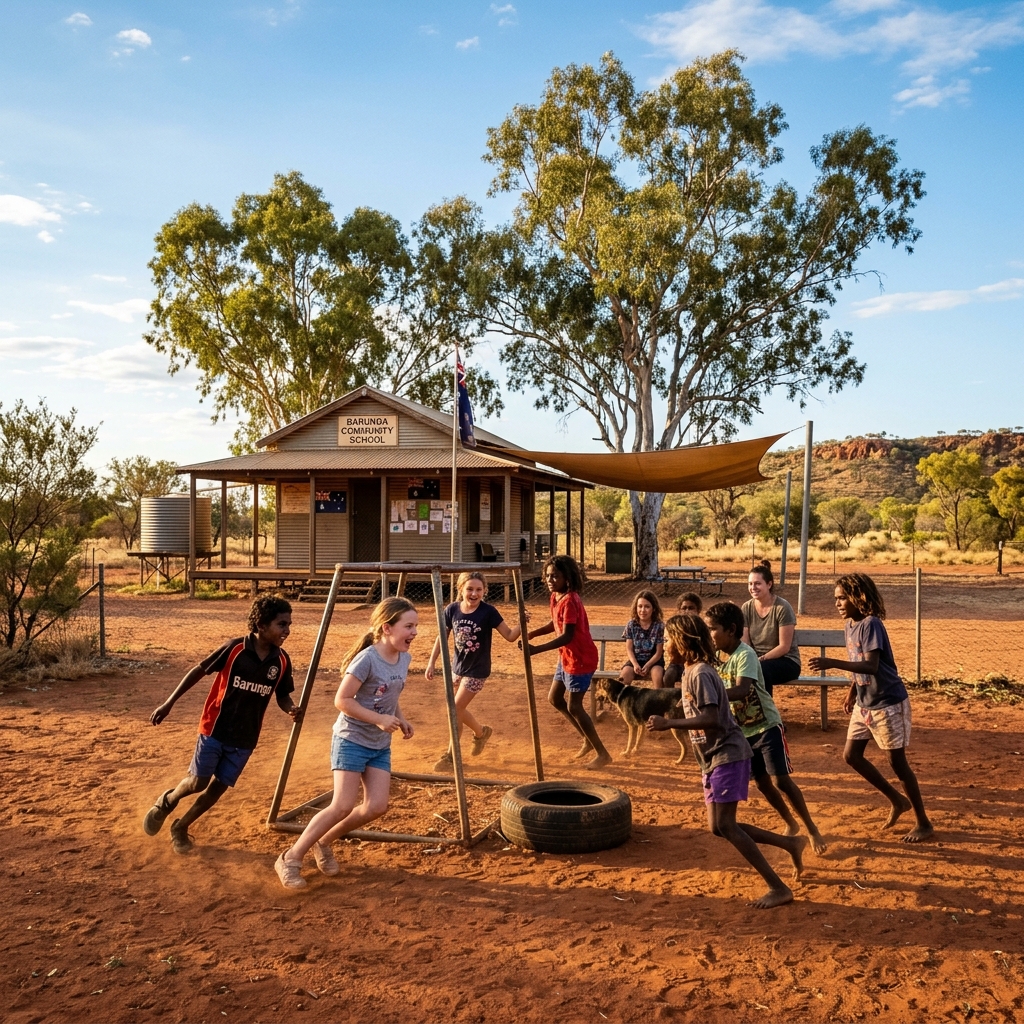
When people in the city talk about the state of Australian education, they're almost always talking about something that's true for roughly 70% of students in urban and suburban schools. The other 30% — in regional towns, rural areas, and remote communities — are living a version of Australian schooling that looks dramatically different, and that policy conversations too often flatten into a footnote.
I grew up in a town of 3,000 people in the New England region of NSW. My primary school had 180 students across seven year levels. My high school had 300 students across six year levels, and it was considered large by local standards. When I moved to Sydney for university, I was told — repeatedly, and with good intentions — that I'd had "limited opportunities." What I'd actually had was a different kind of education, one that I've spent a lot of time thinking about since.
The case for small schools
Small schools in regional and rural Australia get a bad press that the research does not fully support. Studies of educational outcomes at small schools consistently find that the disadvantages (limited subject offerings, fewer specialist teachers, fewer peer interactions) are often partially offset by substantial advantages: smaller class sizes with genuinely individual teacher attention, stronger school-community relationships, multi-year teacher-student relationships that allow for greater knowledge of each individual child's needs and character, and a culture in which every student is known to every teacher.
A school with 85 students does not have the maths extension class or the specialist music program of a school with 1,200. But it also does not have a child who falls behind and isn't noticed for two years, or a student who feels invisible in a crowd of hundreds.
The real challenges
None of what I've just written is meant to minimise the genuine challenges of rural and remote schooling. Teacher recruitment and retention is the most pressing one. Many rural schools operate with significant teacher vacancies, relying heavily on short-term contract staff and graduates who stay for one or two years before moving to the cities. The instability this creates is real and harmful — research consistently links teacher continuity to better student outcomes, and children in small communities who have had five teachers in three years have been genuinely disadvantaged.
Subject breadth at secondary level is a related challenge. A regional high school might be able to offer HSC courses in 20 subjects. A metropolitan school might offer 40. For students with specific interests or aptitudes, this constraint can redirect educational paths in ways that wouldn't happen in a larger centre.
Distance education: better than its reputation
For the most remote students, distance education schools — NSW's Aurora College, Queensland's Distance Education School of the Tropics, South Australian Distance Education, and similar institutions in each state — provide structured curriculum via online delivery, correspondence, and in some areas visiting teachers.
Distance education has improved dramatically in the past decade. The COVID pandemic, whatever its educational costs in urban areas, accelerated the development of online teaching infrastructure that has genuinely benefited remote students. Live interactive lessons, collaborative platforms, and better videoconferencing technology mean that distance education in 2025 is fundamentally different from the correspondence textbooks and satellite radio lessons of twenty years ago.
The limitations remain: the social dimension of school — the friendships, the incidental learning, the sport and performance and competition — is genuinely hard to replicate remotely. For many remote families, the "School of the Air" model remains a pragmatic solution to an impossible geography, not an ideal educational experience.
Boarding schools: the secondary school question for remote families
Many regional and remote families face a decision in Year 7 that urban families never have to consider: whether to send their child to a boarding school to access secondary education. The local high school, if it exists, may not offer the range of subjects, specialisations, or social environment that a family wants for their teenager. State-funded boarding allowances exist in most states to help with costs, but the emotional weight of sending a twelve-year-old away from home communities — particularly in Aboriginal families, where Country and kinship connections are foundational — cannot be offset by any payment.
This is one of the most consequential decisions in Australian educational life, and one that barely registers in the national conversation. If you're facing it, organisations like the Isolated Children's Parents' Association (ICPA) and your state's Distance Education centre can provide support that goes well beyond academic advice.
An honest assessment
Rural and remote schools in Australia range from deeply inspiring — led by committed, experienced educators who have built extraordinary community connections — to genuinely struggling, caught in cycles of teacher turnover and resource scarcity that even the most capable leaders cannot fully overcome. The data on this is in the WhatSchool profiles: attendance rates, NAPLAN trends, community context scores, and the note about where each school sits on the remoteness scale.
Use that data as a starting point. And then, if you're choosing a rural school or understanding the context of one your child attends, talk to the principal. The gap between what shows up in a spreadsheet and what a committed rural school principal actually achieves is often the whole story.