Supporting Indigenous Students in Australian Schools
How schools report Indigenous enrolment, what additional support is available, and what the data tells us about attendance and outcomes.
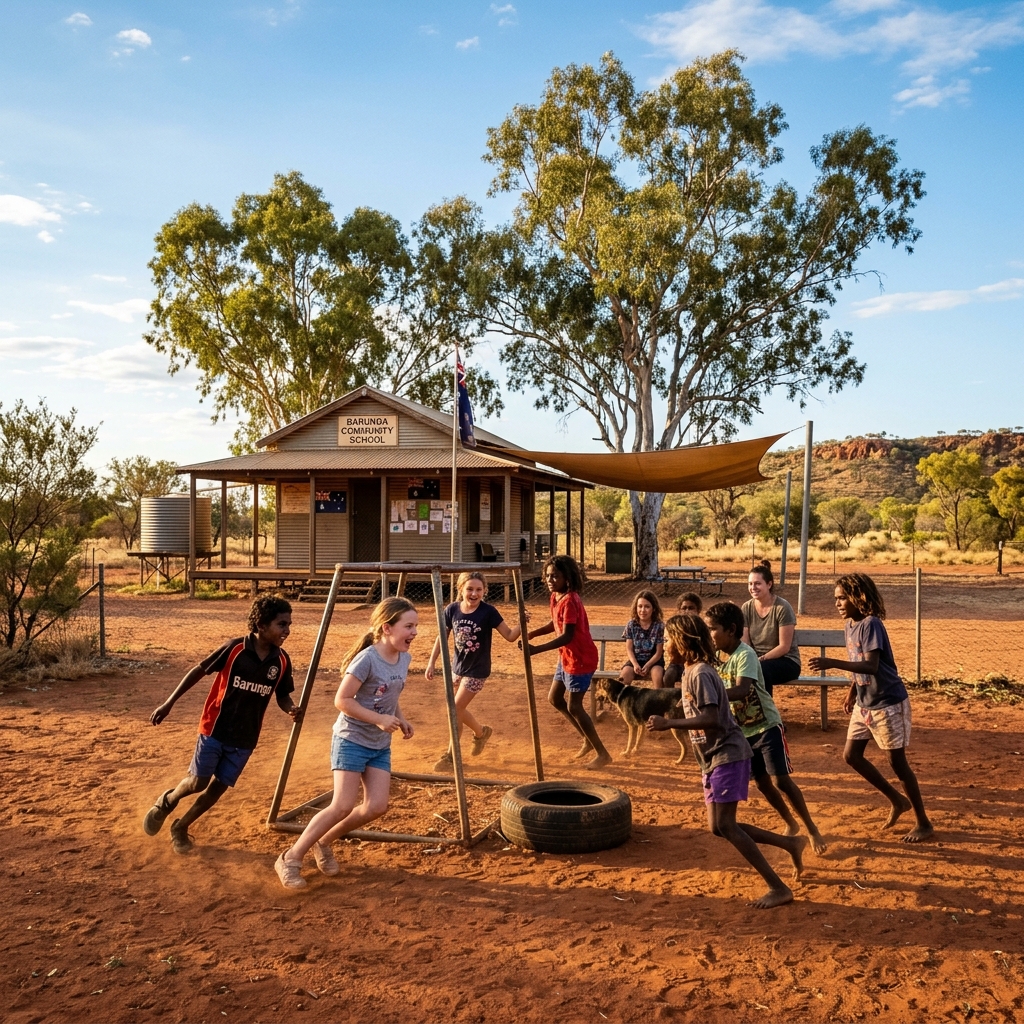
There is a stretch of the Stuart Highway north of Alice Springs where you pass a school that serves two hundred children from communities spread across a hundred-kilometre radius. Some kids travel two hours each way on a bus. The principal told me that her biggest achievement that year was getting the average attendance from 61% to 71%. I had come expecting to write about data. I left thinking about what "educational disadvantage" really means when the nearest supermarket is four hours away and the nearest paediatrician is in Adelaide.
The educational outcomes gap between Indigenous and non-Indigenous Australian students is the most persistent and most discussed challenge in Australian education. It is also one of the most frequently discussed and least genuinely understood. Here is what the data shows, what it doesn't show, and what I think parents — whether Indigenous or not — should actually know about it.
What the data says
ACARA publishes Indigenous student attendance and NAPLAN results separately from non-Indigenous results. The picture is, in aggregate, stark. Nationally, Aboriginal and Torres Strait Islander students have attendance rates approximately 8–10 percentage points lower than non-Indigenous students. In very remote areas, this gap doubles.
On NAPLAN measures, the national average gap between Indigenous and non-Indigenous students in Year 5 reading is equivalent to more than two years of schooling. The gap in Year 9 numeracy is similar.
These figures are real and they matter. They also require significant contextual interpretation.
Structural context, not individual deficit
The education outcomes gap is not primarily a product of what happens in school. It is primarily a product of the structural disadvantages that surround school: geographic remoteness, inadequate housing (which affects sleep and therefore learning), health disparities (hearing impairment from untreated middle ear infections is remarkably prevalent in remote Aboriginal communities and directly affects literacy development), family disruption, cultural dislocation, and the profound impact of historical trauma that continues to shape community wellbeing today.
Schools serving these communities are doing their work in contexts that would challenge even the best-resourced, best-led institutions. Attributing the outcomes gap to school quality alone is both inaccurate and unfair to the teachers and principals working in extraordinarily difficult circumstances.
What government funding does
Schools with significant Indigenous enrolments receive an Indigenous-specific loading under the Commonwealth's Schooling Resource Standard — additional per-student funding that supports Aboriginal Education Officers, cultural programs, and targeted literacy and numeracy intervention.
Aboriginal Education Officers — paraprofessional staff who are often community members themselves — play a role in schools that good data cannot fully capture: they provide pastoral care, cultural navigation, and family engagement support that teachers without community connection simply cannot replicate. The best-performing schools in high-Indigenous-enrolment areas typically have strong, well-supported AEO programs.
Community-controlled schools
Across remote Australia, a growing number of schools are operated under Aboriginal community control — governance structures that put Indigenous communities in direct oversight of the education of their own children. These schools often integrate local language, cultural knowledge, and community practices explicitly into the curriculum, rather than treating them as additional programs bolted onto an otherwise standard education.
The outcomes at well-resourced, community-controlled schools are often meaningfully better than at equivalent government schools — not necessarily in raw NAPLAN scores, but in attendance, engagement, cultural wellbeing, and the things that matter to the communities themselves.
What this means for parents choosing schools
If you are an Indigenous family choosing a school, the questions that matter most are probably not the same ones that non-Indigenous families focus on. The quality of the AEO program, the school's relationship with local community and Elders, the cultural safety of the environment, and whether the school actively incorporates and celebrates Aboriginal and Torres Strait Islander culture are all worth investigating directly — and most schools that take this seriously will have visible, concrete answers rather than generic reassurances.
If you are a non-Indigenous family and the school you are considering has a significant Indigenous enrolment, it is worth understanding what that means in practice. A school that integrates Indigenous perspectives meaningfully — that treats this as a genuine educational priority, not a box-ticking exercise — is likely to provide a richer, more culturally sophisticated education for all its students.
On the Stuart Highway, the principal told me she measures her success not by test scores but by whether kids want to come back the next day. "If they want to come back," she said, "we're doing something right." It is not a metric that appears in any ACARA table. It might be the most important one there is.