Schooling in Remote & Regional Australia
Distance education, small multi-grade classrooms, boarding schools — the unique landscape of rural and remote Australian schooling.
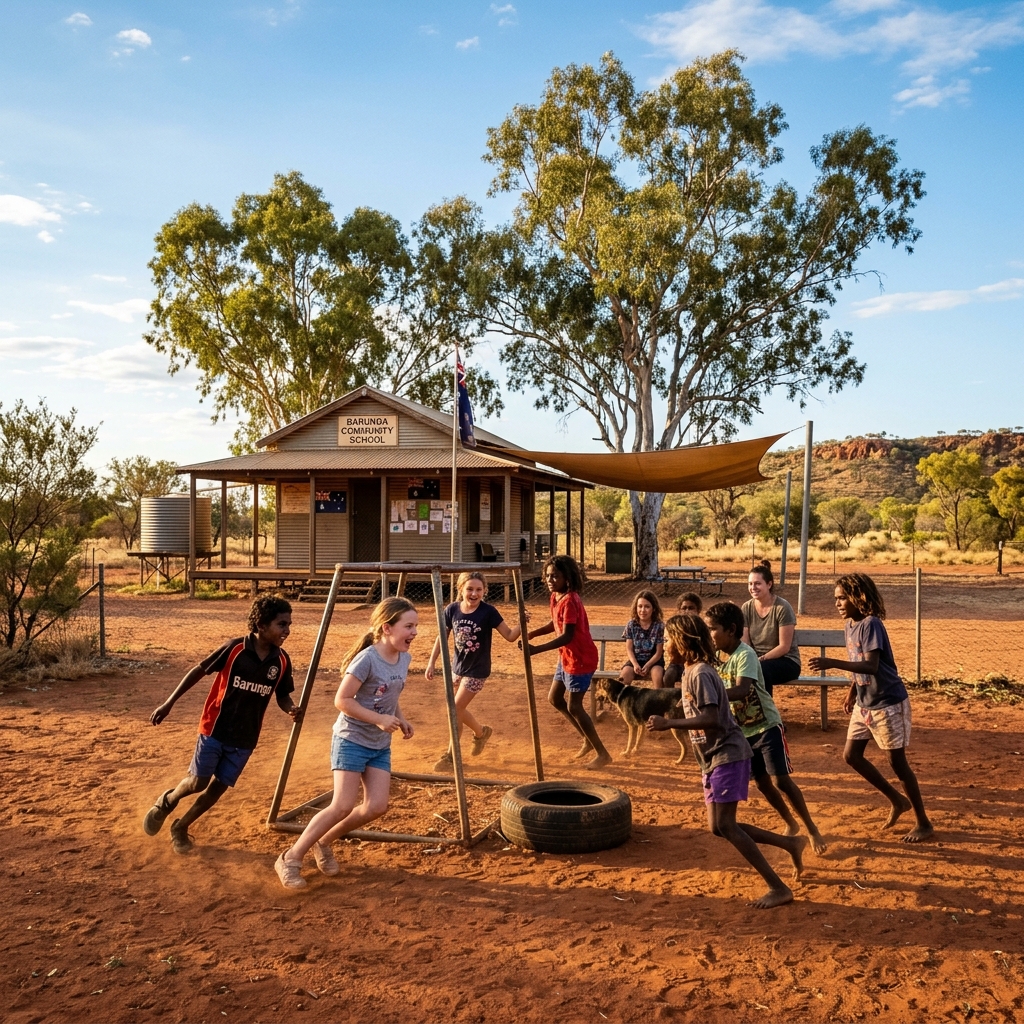
Remote and regional schooling in Australia is one of those topics that urban commentators feel confident discussing without knowing much about. The data — attendance rates, NAPLAN scores, teacher vacancies — gets cited as evidence of systemic failure. The reality, as anyone who has spent time in these communities and schools knows, is considerably more complicated and considerably more humbling.
This guide is for families in regional, remote, and very remote Australia navigating real decisions — and for urban families trying to understand a part of Australian education they're unlikely to encounter firsthand.
The types of school in regional and remote Australia
Small community schools: Many remote communities have a single school serving Prep through Year 6 or Year 10, with 20–80 students across multiple year levels. Multi-grade classrooms — one teacher, three year levels — are standard. The research on small schools is actually reasonably positive about what they can offer: closer teacher-student relationships, a stronger whole-school community, and genuine individual attention. What they can't always offer is subject breadth or specialist teachers in art, music, languages, or sports.
Regional comprehensive high schools: Towns of 5,000–20,000 people typically have a comprehensive secondary school serving the surrounding region. These schools offer a more complete secondary curriculum than small remote schools, including most Year 11–12 subjects, but typically with a narrower range than metropolitan schools. Boarding facilities attached to regional secondary schools allow children from very remote areas to access secondary education closer to home than the city alternatives.
Distance education schools: State-based distance education institutions — NSW's Aurora College, Queensland's The Correspondence School, South Australia's School of the Air, WA's SIDE, and others — deliver formal curriculum to students who are too remote to attend a physical school. This includes both students on isolated properties and students with specific health or other requirements that prevent school attendance. Online delivery has substantially improved the quality of distance education in the past decade.
The teacher recruitment and retention challenge
The most significant structural challenge facing remote schools is teacher recruitment and retention. Remote teaching positions are harder to fill, have higher turnover, and often use short-term contracts and new graduates who move on after one or two years. The practical consequence is instability: children in remote communities may have five or six different teachers over a three-year period. Research consistently links teacher continuity to better outcomes, and this instability is one of the clearest ways in which remoteness translates into educational disadvantage.
State governments use financial incentives — location allowances, subsidised housing, additional leave entitlements — to attract teachers to remote positions. The incentives help at the margins; they haven't solved the problem.
Boarding schools for secondary: a major family decision
Many remote families face a decision in Year 7 that urban families never encounter: whether to send their child to a boarding school to access secondary education. The local school, if it exists past Year 6, may not offer the full range of Year 11–12 subjects, the sports programs, or the social environment that families want for their teenager.
State governments provide boarding allowances — the Commonwealth's Assistance for Isolated Children scheme and state-level supplements — to help offset costs. But the financial support doesn't offset the emotional weight of this decision, particularly for Aboriginal families where separation from Country, family, and community is not a logistical inconvenience but a cultural loss.
If you're navigating this decision, the Isolated Children's Parents' Association (ICPA) is an invaluable resource: they provide practical support, advocacy, and a national network of families who have been through the same choice.
Using WhatSchool data for remote schools
WhatSchool Australia displays the remoteness classification for every school — major city, inner regional, outer regional, remote, and very remote — alongside all NAPLAN and attendance data. This classification is essential context. A school with 74% attendance in a very remote classification is not the same as a school with 74% attendance in an inner regional one. Compare within similar remoteness categories as well as similar ICSEA bands.